


Posted by Brette Bennett on Thu, Mar 28, 2013 @ 10:44 AM
One is known for high-end fashion and accompanying high prices – and the other for affordability. But they’re both committed to delivering consistent, high-quality service to their customers. And that’s why a recent Market Force Information study found that Nordstrom and Kohl’s, respectively, are America’s No. 1 and No. 2 fashion retailers.
In addition to earning the top overall spot, Nordstrom also took the “Service” category – followed by Banana Republic, American Eagle, Express and Dillard’s.
The survey studied more than 4,000 consumer opinions about specific fashion retailers, and then took into consideration each chain’s number of physical locations to calculate weighted results.
The ability to deliver superior customer service is a crucial component to defining consumers’ perceived experience with a particular retailer – and building a loyal bond that brings customers back.
But the failure to deliver on customer expectations can cause retailers to flounder. Take Radio Shack, for example. Once regarded as a leading consumer electronics retailer, it now falters in its ability to connect with customers. A recent survey of 10,000 consumers by Temkin Group Research ranked Radio Shack dead last – for the third consecutive year – in its customer experience.
Radio Shack also scored the lowest across consumers’ perceptions of “functional,” “accessible,” and “emotional” components of service delivery.
Particularly in today’s competitive landscape, it’s crucial for retailers to know as much as possible about their customers. That’s why analytics – from loyalty programs to targeting – are becoming even more powerful business development strategies. But such programs assume the in-store customer experience is strong enough to make a shopper return to cash in on special offers.
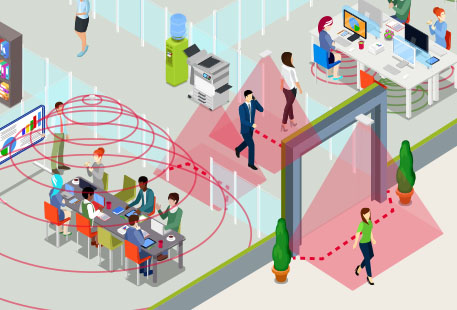
That’s why retailers should also use analytics to understand how consumers interact with their stores – from the moment they walk through the doors until they check out. Thermal people counters can accurately and unobtrusively capture the analytics that quantify a store’s actual traffic patterns – including peak and low-time trends.
The same data can also help feed an intelligent checkout management solution that helps improve staff scheduling and deployment. It even predicts the number of staffed checkouts needed in 15- and 30-minute intervals.
With that information, managers can adjust and allocate front-end and other staff according to real-time information – and help ensure each store delivers the service that nurtures healthy, long-lasting customer relationships.
Posted by Brette Bennett on Wed, Dec 19, 2012 @ 03:28 PM
Retailers can now unobtrusively detect shoppers’ patterns and capture an unprecedented door-to-door view of their behavior patterns thanks to a partnership between Irisys and WirelessWERX, a leader in in-store behavioral analytics. The result is one of the most complete depictions of retail shopping behavior ever provided.

Posted by Chris Giallanza on Fri, Oct 26, 2012 @ 10:30 AM
For today’s consumers, grocery shopping primarily remains an in-store task. The lack of online options drives customers into physical locations, making service a key differentiator for grocers.
Failed online ventures emphasize the limited market options for supermarkets, as seen in 2001 when online grocer Webvan filed for bankruptcy after failing to convert and sustain a strong following of online buyers.
But the lack of online options does not alleviate grocers from the pressures of competition.
Customer experience remains a dominant focus for supermarkets, as they strive to satisfy shoppers every time they enter a store.
For grocers, big crowds and long checkout lines are two of the biggest concerns, according to the 24,000 respondents of Consumer Reports’ 2012 supermarket survey.
But high-tech in-store solutions are becoming effective tools to manage crowds, shorten checkout lines and keep customers happy.
Thermal-powered technology and checkout management systems can help grocers acquire new customers, retain them, and improve their shopping experiences.
Advanced technology can observe customer behavior and convert data into valuable footfall analytics – providing grocers with a roadmap for critical improvements. A thermal-powered checkout management system, for example, feeds grocers extensive data from non-intrusive infrared sensors installed over key points at the front end. Based on shopping patterns observed and learned over time, the system predicts how many staffed checkouts will be needed in 15- and 30-minute intervals.
In essence, thermal technology can translate to happier, more loyal customers and can improve bottom-line performance.
Posted by Chris Giallanza on Fri, Sep 21, 2012 @ 12:31 PM
Technology plays a role in nearly every facet of our lives. Innovators work tirelessly to find the next big idea to make life easier. And the world of retail is not immune.
Groundbreaking ideas have completely transformed the entire shopping experience – from the once awe-inspiring automatic doors to the revolutionary introduction of ecommerce. And traditional in-store shopping still has several advantages over online, making it a prime target for high-tech improvements.
Today, significant innovations in retail technology have circled back to the front end.
But from self-checkout aisles to which we’ve become accustomed to smart phone checkout apps, recent upgrades can burden customers with the task of playing cashier.
On the other hand, what if retail technology improved the shopping experience by making the store itself smarter?
An integrated system that compiles data about shopper traffic both from the entrance/exit doors and the checkout could draw a roadmap for substantially improving store operations – enabling staff to emphasize customer service.
The various components of the system would have to work together seamlessly, collaborating to produce real-time analytics so managers could ensure sufficient registers are staffed as traffic fluctuates. And this system would have to do more than just store information; it would have to learn from history – constantly uncovering improvement opportunities.
Most importantly, if shopper traffic is to be monitored, customers should know their privacy is protected. The tracking system should be non-intrusive – utilizing innovation to develop advanced technology that detects people without the use of video cameras.
Rest easy, retailers. Such a solution exists. Click here to learn more.
Posted by Chris Giallanza on Tue, Jul 17, 2012 @ 09:54 AM
Irisys’ checkout management and people counting solutions change the way consumers shop, increasing profits and customer loyalty for retailers. And with more than 82 percent of retail executives looking to make customer service a priority in 2012 – according to a survey by the National Retail Federation – Irisys thermal-powered checkout technology may be key in improving your customers’ shopping experience.

Posted by Chris Giallanza on Tue, May 08, 2012 @ 10:47 AM
In-store or online shopping? The retail industry continues to be pulled back and forth. Some have adapted by providing both options to their customers, while others have implemented new ways to profoundly enhance the traditional shopping experience.
Either way, efficient checkout remains one of the most critical aspects of retail.
Supermarket News recently explored what the nation’s largest traditional grocery chain is doing to improve customers’ front-end experience. See the full article here.
Posted by Chris Giallanza on Fri, Apr 20, 2012 @ 10:25 AM
In retail – and in any direct-to-consumer business, for that matter – keeping your customers happy can significantly boost your bottom line. And shorter lines make happier customers, especially at supermarkets.
Each year, Consumer Reports surveys its readers about their grocery store shopping experiences – giving consumers a voice to bring forth any and all concerns. And each year, complaints about crowds, lines and checkouts always seem to be top of mind for many U.S. grocery patrons.
In the 2012 survey results, the No. 1 overall complaint cited by 27 percent of the more than 24,000 respondents was – you guessed it – not enough open checkout lanes. Twenty-five percent pointed out poor selection, long lines or lousy food while 14 percent said they have had enough of the crowds.
Retailers are challenged to find cost-effective ways to keep customers satisfied through the front-end – and this is the age of new technology. Thermal sensors can give retailers an unprecedented advantage over their competition by streamlining checkout processes while gathering critical footfall analytics. Hi-tech checkout management systems offer significant returns on investment, such as:
- Improved customer service;
- Reduced wait time; and
- Manageable labor costs.
For supermarkets, alleviating customers’ top complaint may directly influence their loyalty, a topic on which the survey also touched.
One-third of respondents said they have abandoned a nearby grocery store in the past year for an assortment of reasons – from a search for lower prices to employee rudeness and everything in between, which includes long lines, no open checkouts and crowds.
One of the many definitions for “progress” is movement toward a goal or to a further or higher stage. Eighty-two percent of retail executives said improving customer service would be a priority in 2012, according to the National Retail Federation (NRF) Foundation.
Checkout management technology provides an innovative front-end solution for common customer complaints.
Now that’s progress.
Posted by Robert Clarke on Fri, Sep 23, 2011 @ 05:05 PM
As many of us know, a well managed front-end can alleviate customer dissatisfaction in retail. This begs the question, why do so many grocers continue to have too few lanes open during the busiest operating hours?
When evaluating the productivity of their front-end, many retailers are turning to Queue Management systems, which are known to enhance the results of workforce management. Comprised of infrared queue monitoring detectors installed over checkout lanes, the technology monitors that checkout lines and number of people entering and leaving the retail outlet. The company’s Predictive Algorithm software uses this information to calculate how many checkouts to be opened within 15 - 30 minutes to meet a predetermined service level.
There are many innovative workforce management solutions to help retailers and grocers maximize staff productivity and bolster customer service. For more information on these solutions, read the Grocery Headquarters’ article on “Working it Out” – solutions for workforce management.